Showing posts with label scarf. Show all posts

Wednesday, February 11, 2009

So Much for my Anti-Garter Bias

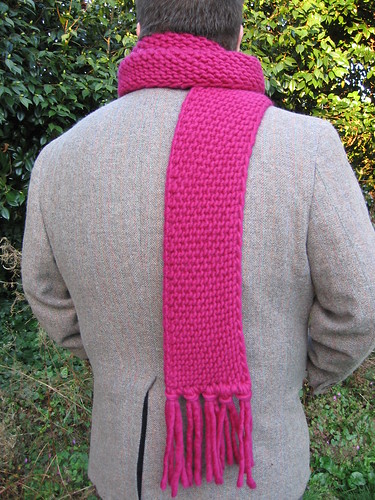
A different angle on a traditional garter-stitch scarf, I knit this both as a means to rectify a gap in my Knitter's Education and to create something eye-catching and fun-to-knit with this big, bold yarn. I'd never really made the de rigeur beginner's garter-stitch scarf and wanted to play with that stitch patter, but I also didn't want to make a plain, rectangular scarf with horizontal garter stitch, so I thought I'd try knitting on the bias. Not long after that, a pile of Brown Sheep Burley Spun caught my eye and insisted that I play with it. It comes in some really bold colors, and I LIT'rally couldn't stop thinking about it until I realised it was perfect for the garter stitch-on-the-bias scarf I so wanted to make. At the same time, Davitron (seen below modeling the scarf) needed a scarf, but hates knitting them, so really it was a win-win situation. ;o)


Knit in super-bulky yarn in a vibrant color, the big stitches and diagonal garter ridges are eye-catching and mask the super-easy backwards-loop cast-on used to increase. The slipped-stitch edge on the 'increase' side serves both to hide the increase stitch and mirrors the knit two together decrease used on the decrease side.

The full pattern text is published here, but the pattern is also available for download as a free PDF at the bottom of this post.

Size:
The model shown measures approximately 6"x7'10", post-blocking.

Gauge:
Not super-important for scarves, but here it is: 8 sts & 12 rows = 4" in st st.

Materials:
- Brown Sheep Burley Spun, 2 skeins in fuchsia, OR approximately 260 yards of super-bulky yarn of your choosing in your favorite color.
- US 13 needles, or the size you need to obtain gauge.

Make it!
The construction of this scarf can, essentially, be broken down into three major parts: increasing, adding length, and decreasing.

Increasing:
-CO 3 sts
-Sl 1 knitwise, co1 using backwards-loop cast-on, k1, co1, k1
-next row: k4, p1
[next row: sl1, co1, k all sts to last st, co1, k1
-next row: k all sts to last st, p last st] repeat until you have 20 sts on your needle.

Adding Length:
Once you have 20 sts:
[1: sl1, m1, k all sts to last 2 sts, k2tog
2: p1, k all sts to last st, p last st]
-one edge of the scarf (the "m1" edge) will be longer than the other. Repeat these two rows until the "long side" measures the desired length, then...

Decreasing and Binding-Off:
Once you have reached the desired length for your scarf:
[3: k2tog, k all sts to last 2 sts, k2tog
4: p1, k all sts], repeat these two rows until you have 2 sts left.
-Slip the first stitch (the one closest to your hand on the "working needle") over the 2nd stitch. Cut a tail approximately 10" long, pull this through the last stitch and weave in ends.

Finishing:
Block and apply tassels as desired.

The pattern PDF is also available as a FREE download! Click the button below to download the PDF (you do not need to be a Ravelry member to download from this page).

Happy knitting!

EDIT: Visit TricotChico.blogspot.com for more knitting patterns by Homero Luna.

Tuesday, February 3, 2009

In Which TricotChico Knits a Noro Striped Scarf

This blog has been a long time coming, and I'm really excited to finally be able to post it! The knitting has been finished for quite some time, but since this project is all about color, I wanted to be sure that I was able to get photos that effectively conveyed what it is that I got so excited about. Many thanks to Lee for offering to shoot this scarf for me when my basic digicam wasn't equal to the task at hand. Thankfully, we were both at Sarah's "stuporbowl" party (it was more about the beer and commercials than the game!) and took the opportunity to get some yarnography in. I'm really fortunate to have such awesome people in my life! [BTW-Sarah makes some AWESOME vegetarian chili! If you ever receive an invite to share it, I say you clear your schedule and get there early!]

The subject matter is a project that it seems like everyone and their mom has knit (the Noro Striped Scarf), but my resistance to Noro's self-striping colorways precluded me from engaging in this sort of thing for quite a while. Many of the more vibrant colorways (of Kureyon, especially) tend to come across to me as clown barf; too many bright colors all at the same time! However, though many of the color combinations were unappealing to me, some of the colors individually are/were quite lovely and they chanted my name oh-so-seductively whenever I was near a display of Kureyon at one of PDX's many LYS's. Ultimately, I found several colorways that were rich, subdued, enticing, and maddeningly desirable. You know how it goes: you see yarn and you must. have. it. You can't stop thinking about it until you take it home or find that project that will show it off most wonderfully--or both. And so it was with me and this scarf. Truly, I found four or five colorways that spoke to me, but these two (Noro Kureyon 185 [purples, greens, oranges, yellows] and 195 [blues, greys, olive, ochre, black]) really complimented each-other well.


I was really charmed by each colorway for similar reasons: the colors individually were amazing and together they were breathtaking. I was excited to see how they'd play together, and play they did!!! I knit this during the Snowpocalypse of 2008 and the color changes and combinations really kept me from going mad when PDX was, effectively, shut down by more than a foot of snow. It was amazing to see the rich cobalt blue of the darker colorway knit up next to the ripe papaya of the more vibrant one, and then there were combinations like lilac vs. olive drab, purple iris vs. mahogany, saffron vs. navy, mandarin orange vs. candied date, and goldenrod vs. dryer lint--even the most unlikely 'color' hit its stride when partnered with the right hue! I now understand what Jared Flood (a.k.a. BrooklynTweed) meant when he said this project seems almost like cheating, but then I remember the sage advice of my friend Karin: "Sometimes a B+ effort is good enough!"


Again, pretty much everyone and their mom has knit this scarf, but here is how I made mine: I used a tubular cast-on to cast on 36 stitches, then slipped the first stitch of every row knitwise, *k1, p1* to the last stitch, purl the last stitch. The resulting slipped-stitch edge is lovely, hides the yarn that you carry up the side for easy color-changes, and doesn't have any of the problems of created a bowed scarf that I've heard others mention when they slip the first and last stitch of every other row. I knit like mad until I had used all four balls of yarn (and a couple of yards of green from Kureyon colorway 172 left over from another project), then finished it up with a tubular bind-off.


After a couple of gentle washes (to encourage softening of the yarn) and a good soak in Kookaburra wool wash (to encourage huffing of the yarn), this scarf is hands-down putting all my grey scarves out of business!

Thanks again to Lee and Sarah for lending the skills and space (respectively) that made this post happen.

Saturday, January 3, 2009

Knitting Gets Harcore.

Way back in August 2008 I started a Lace Ribbon Scarf designed by Veronik Avery. (Here's a link to my Ravely Project Page, for those Rav Members amongst us, though most of the project info is in this blog post.) I was using some effing DELICIOUS yarn--Dream In Color Smooshy in the Cocoa Kiss colorway. I was also delighted to use Brittany needles in size US3. Not only are these needles sustainably harvested and packaged in the most environmentally-friendly way possible, they're just plain pretty.

When I started this pattern I was committed to using only one skein of yarn. I originally cast-on 44 stitches for a scarf with four "ribbons" (the pattern calls for 53 sts to create a scarf w/five "ribbons"). While knitting, I noticed that the yarn tended to stain the lovely birch needles.


It was more of an observation than anything, I mean, knit happens, right? =oP The picture above shows a stained needle next to a brand-new one, to illustrate the extent of the color transfer from the yarn. This was after knitting about 4' of scarf, at which point I realised that the remaining yarn from this skein would only allow a scarf of approximately 5.5' in length. I really wanted a longer, narrower scarf, though, so I frogged the entire creation and started over, this time casting on 35 sts for a scarf with 3 "ribbons".

Sometime during the knitting of the newer, narrower scarf, one of my pretty Brittany needles snapped. :o(


Now, this pic shows a needle that is snapped in two places, and I'll tell you about the 2nd snap in just a moment. The first break happened near the end with the lovely finial, and was actually the result of the needle snagging on a friend's couch as I picked up my knitting bag. A broken needle didn't stop me, though; I called the good folks at Brittany and told of my mishap and they sent a replacement needle post-haste, tout-de-suite, and free gratis [sic].

(As a quasi-aside: the pic above also shows a brass safety pin in my knitting. I used this to keep track of which row I was on in the lace ribbon pattern. As the pattern repeats over 23 sts, I'd place the safety pin in the stitches on the first row and count from there when I needed to check my progress in the pattern.)

In the meantime, I wrapped a rubber band around the broken end in order to stop my work from sliding off the broken end, and I kept on knitting! This was my first lace work and the pattern was so easy to memorize, quick to knit, and yeilded such lovely results, that it was all I worked on from the time I cast on those original 44 stitches.

Unfortunately, while waiting for the replacement needle that Brittany had been so good to send, I sat on my knitting (there may or may not have been beer involved on the night in question. My Log may or may not have seen something that night)! Ergo, two breaks in one needle. Fortunately, however, the replacement arrived the very next day, so I was able to transfer my work to it and keep on knitting.


The scarf is now finished and has been for quite some time. Its unblocked measurements are approx. 5.5"x82". It needs to be blocked to square it out, though, and I've had a hard time locating a spot in this house with wood flooring which would be suitable for pinning down such a scarf. Also, Dream in Color has a tendency to bloom a fair bit, so I expect it to gain some size once it's been washed and soaked (mmmmmm, kookaburra!!!).

More photos of this to come, but in the meantime, I think this last photo give a fair representation of the pattern and general look of the scarf.